Accuracy, dimensions and reconstruction
Model snapshot: October 22, 2026, after the photo-matched overhaul, the Night Sky
phone color, the six case colorways and the Mous, Thinborne and Nomad cases with
their review fixes, all recorded in REVIEW.md. Product links and image
navigation are in PRODUCTS.md; commands and file ownership are in
WORKFLOW.md. Every number below was checked against
measurements.json, the root calibration reports or the source scripts, except
the Night Sky photograph ratios, which come from that calibration run (its camera
and tools are not in the project). The Mous, Thinborne and Nomad numbers come from
their brand builds after the review fixes; their matched-view metrics were
re-measured with reference_metrics.py on those final renders.
Read this page before using any number for a buying or fit decision. Most of the model is an informed reconstruction from marketing images, not manufacturer CAD.
Basis of each value
| Label | Meaning |
|---|---|
| Published | Stated by the manufacturer or a retailer listing. |
| Apple asset | Measured on Apple's unmodified Star White USDZ, which keeps Apple's metric scale. |
| Photo estimate | Measured in manufacturer images through a fitted camera or a calibrated scale, then authored. Typical error is a few tenths of a millimetre, more for depth. |
| Reconstruction | Inferred from shading, construction logic or several partial views; no image measures it directly. |
| Calibration | A material value tuned so a photo-matched render reproduces a photograph under this project's studio. It is not a measured optical property. |
Dimension summary
| Item | Value used | Basis | Source |
|---|---|---|---|
| iPhone Duo, closed | 84.1 × 117.8 × 11.3 mm | Published | Apple specifications |
| 84.78 (with hinge cover) × 117.95 × 11.0 mm frame | Apple asset, kept unscaled | Apple USDZ | |
| iPhone Duo, open | 164.6 × 117.8 × 5.2 mm | Published | Same |
| 164.91 mm frame span about the hinge axis X = -41.08 mm | Apple asset (Landscape pose) | Apple USDZ | |
| Latercase MagLock, all five colorways | 1 mm shell, 20 g | Published | Latercase listing: Midnight, Classic, Coffee, Crimson, Willy Blue |
| 83.35 × 119.7 mm outline, 1.8 / 2.7 mm rolls, bead, openings | Photo estimate | Official Midnight and same-mould images | |
| PITAKA Edge Midnight / Sunset | 1.3 ± 0.1 mm wall; back case 19.1 / 20.13 g, suite 35.66 / 36.7 g | Published | Midnight rear, Midnight suite, Sunset rear, Sunset suite |
| PITAKA Edge California Dream / 600D Black/Grey | 1.3 ± 0.1 mm / 1.0 ± 0.1 mm wall; suite 35.71 / 32.13 g; back-only weights not published | Published | California Dream, 600D |
| 84.0 × 120.25 mm outline, cap, edges, openings; one 1.3 mm shell for all four designs | Photo estimate | PITAKA end, side and flat views | |
| Mous Ultra Thin, Aramid Fibre | 1.65 mm back, 0.7 mm side walls; with the phone 85.70 × 119.9 × 18.15 mm closed and 166.53 × 119.9 × 12.65 mm open; weight not published | Published | Mous, Duo variant |
| 85.57 × 119.82 × 18.15 mm closed, 166.51 × 119.82 × 11.92 mm open; surround, cutouts, front window | Photo estimate (closed depth by construction; the published depths conflict) | Mous render 06 and 08, real photos Lifestyle-3 and -4 | |
| Thinborne Super Thin, all three colorways | 0.90 mm wall; 21.3 g (spec table; the headline says 21.5 g) | Published | Thinborne: Black, Crimson, Navy |
| Envelope 0.93 mm outside Apple's frame; camera bezel crest Y 11.0 mm; openings; 1.0 / 1.5 mm weave cells | Photo estimate | Thinborne's CGI open views and real photographs of the bare pieces | |
| Nomad Mag Leather Back, all three colorways | 2.2 mm plate; weight not published | Published (Nomad's generic help article says 2.05 mm) | Nomad: Black, Rustic Brown, Saddle; help article |
| 81.99 × 116.69 mm outline, notch, ring opening; ring crest 0.72 mm above the lens covers | Photo estimate (ring section: reconstruction) | Nomad's 3840 px straight backs, side-profile video | |
| ohsnap Snap Grip | Ø58.0 × 3.0 mm | Published | ohsnap product and FAQ |
| ohsnap Grip Stand | 59.4 × 85.1 × 3.4 mm; 350° hinge | Published | ohsnap (thickness, hinge); NFM lists 2.340 × 3.350 in, converted and rounded |
| Radial layout, cap, 19.0 mm arm, hinge position | Photo estimate | Official renders through fitted cameras | |
| MOFT Snap Fold, both finishes | 67.0 × 88.9 × 7.5 mm, about ±0.7 mm | Photo estimate (thickness: reconstruction) | MOFT three-view calibrated by Apple's lens rings; MOFT publishes no dimensions |
| Magnet centre, bare phone, Latercase, Mous, Thinborne and Nomad | 55.5 mm above the phone bottom, centred | Photo estimate | Spigen's published Duo ring image; Nomad's MagSafe-charger photograph (54.85 mm) |
| Magnet centre, PITAKA | 56.6 mm above the phone bottom, centred | Photo estimate | PITAKA interior ring image |
Apple's AR mesh differs slightly from the published dimensions and has protruding controls. It was kept unscaled instead of being deformed to match the published box. All accessories use the same metric scene scale.
Phone
Source, construction and articulation
The phone is Apple's official Star White USDZ, linked from Apple's iPhone Duo page. Its exterior vertices and metric scale are preserved and the USDZ file is unchanged. Every change to Apple's parts is a visibility, material or object-transform change, or a separate derived object.
The file has two variant sets, Pose (Closed, Landscape) and Color (Night_Sky, Star_White). The build imports Star White; Night Sky is applied from data on the same geometry (see Phone colors). Its rear is a layered AR stack: an outer frosted shell flush with the frame (Y = 5.50 mm, camera-plateau top 9.141 mm) over an inner backing (5.00 / 8.69 mm), a matte logo underlayer and coplanar overlays. Before this overhaul the model showed the inner backing, which caused the broken ring, gray bar and notches around the plateau and the floating logo. Derived parts, all built from Apple's meshes:
- Rear glass: a copy of the outer frosted shell without Apple's AR custom normals. Only its flat plateau top is re-triangulated around a 4.1 mm flash window (r 2.05 mm at X = -8.35, Z = 98.21 mm). The original shell, the backing and the overlays stay hidden in the blend for the case samplers.
- Flash lens: a flat, flat-shaded cap in that window carrying Apple's own flash appearance (its diffuser ring texture and flash photograph, baked into one texture). Its rim runs 0.02 mm under the window edge.
- Lens covers: Apple's two cover sheets as solid 0.25 mm sapphire slabs (IOR 1.77, Y = 10.978-11.228 mm).
- Switched-off outer display: Apple's file has no cover glass in front of its display layer, so a black glossy copy of the display outline sits 0.05 mm behind it. It shows only where a view hides the display image.
Articulation (Apple asset plus reconstruction). Apple's Closed pose is the closed state and its Landscape pose is the ground truth at 180°. That pose turns the front half 180° about X = -41.08 mm, Y = 0, so the frames abut with a 164.91 mm span (published 164.6 mm), and places the hinge cover 1.573 mm further out. The motion between the two poses is reconstructed:
- The front half turns about the same axis.
- The hinge cover turns by half the angle and retracts along its own axis by 1.573 × (1 - cos(opening/2)) mm, which keeps it clear of both frames at every 5° step.
- The inner display shows Apple's Landscape wallpaper (2048 × 1024, Apple's UV mapping). Its 23.78 mm hinge zone bends at constant length with continuous tangent and curvature, fitted to Apple's closed fold (0.15 mm rms), and matches the Landscape pose in a matched render (silhouette IoU 0.995). Within about 15° of flat the display surface, 0.26 mm behind the hinge axis, needs a few micrometres of stretch.
- Twelve morph targets at 15° intervals, carried by the hinge cover, give smooth bending in the viewer. Between keys the linear blend sags each strip end up to 0.027 mm toward the hinge, so every display and bezel strip continues 0.15 mm under its rigid panel. The joins stay covered at every opening (checked every 0.5° in Blender and every degree in the viewer).
- Matte black hinge-zone bezels follow the bend; their darker ends match the hinge-zone block in Apple's open-display photograph. No crease is drawn: Apple's photographs show none (the line at the fold in Apple's Mail screenshot is the app's split-view divider).
Apple's only intermediate-angle photograph (the hinge-side durability view) fits best near 75° once a front-half landmark is used; at that opening the frame, hinge-cover and bezel widths match it within a few pixels. This is a visual articulation, not Apple hinge CAD or a mechanical simulation.
Phone materials and calibration
All values are linear base colours unless marked. They were tuned against Apple's
photographs in the fitted cameras ref_apple_display, ref_apple_hinge_open and
ref_apple_rear34, and are calibrations, not measurements.
| Part | Value | Note |
|---|---|---|
| Star White rear glass | (1.0, 0.99, 0.96), roughness 0.42, Specular IOR Level 0.25 | Apple's authored (1.0, 0.98, 0.94) read warmer and 2-8 levels darker than both photographs |
| Logo | Opaque polished ink (0.88, 0.87, 0.83), roughness 0.06 | Flush in the shell's logo opening |
| Titanium frame, buttons, lens rings | (0.88, 0.855, 0.815), roughness 0.05 | Apple's mirror roughness; Apple's authored tint reads yellower than its photographs |
| Hinge cover | Metallic satin, roughness 0.28, 0.04 mm albedo grain at 5 % rms | Matched satin field p50 199 against 202 |
| Lens covers | Clear sapphire, 125 nm MgF2 film, roughness 0.07 | Faint blue residual reflection |
| Interior blacks | Specular IOR Level 0.1 | Removes most caustic crackle in the lenses |
| Displays | Emission only, strength 1.2 | Apple's 1.75 suits AR Quick Look and rendered 1.3-1.5 × Apple's photograph here |
| Switched-off display | Black cover glass, roughness 0.03 | Assumption about glass; Apple supplies none |
Matched results (sRGB luma, photograph / model, 2048 px). The display, flash, logo and lens regions are the phone owner's last-round measurements; the switched-off front, hinge cover and rear glass are confirmed in the final renders:
- Closed-front display: sky 181 / 182, lower sky 201 / 205, mountains 87 / 83, sand 129 / 120.
- Display switched off (Latercase front photograph): median 0 / 0 (22 before the cover glass).
- Hinge-cover satin field: p50 202 / 199 (172 before); grain 2.5 / 2.3.
- Rear glass: 238 / 232 (hinge view) and 235 / 233 (rear three-quarter).
- Flash: 226 / 216 and 224 / 213. Logo-to-glass linear ratio 0.87 / 0.84.
- Rear lenses (medians): 40 / 28 and 35 / 18.
The remaining phone differences come from the shared studio, not the materials: the rear lenses and front-camera hole mirror dark parts of the studio and read darker and more neutral than Apple's indigo; the polished frames' mirror structure differs; the Star White glass has no top-to-bottom sheen. MOFT's own render of the Duo conflicts with Apple's photographs (back 196 against the model's 233, hinge strip 138 against 80); Apple's photographs govern the phone.
Phone colors
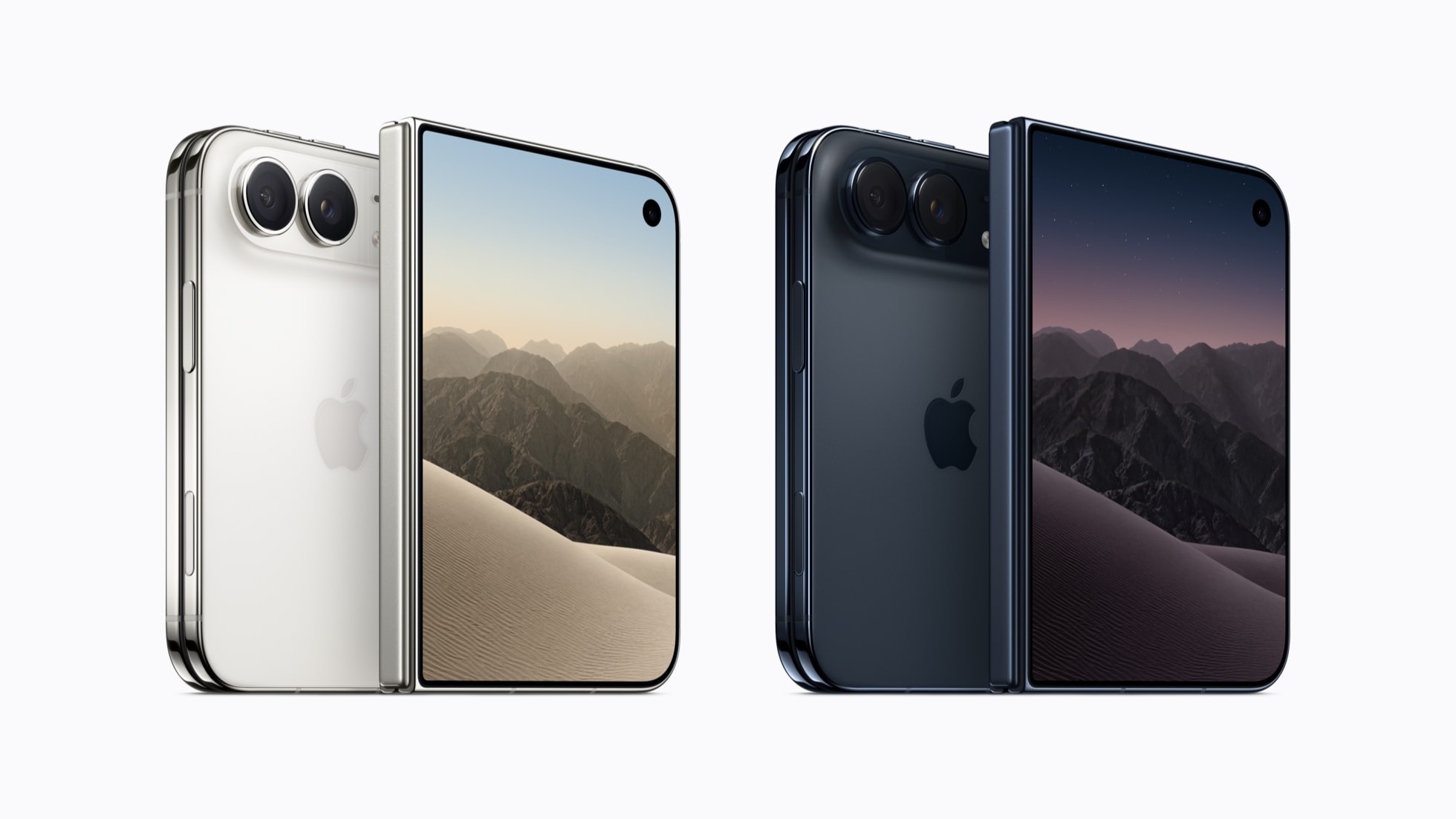
Basis: Apple asset plus calibration. Both of Apple's colors, Star White and Night Sky, use the same geometry, and Apple's USDZ already carries both as its Color variant set. Switching the variant changes 34 shader inputs across 20 materials and swaps both wallpapers and the speaker and microphone grilles. Night Sky is therefore Apple's own variant, recalibrated where Apple's photograph disagrees with it. It is not an invented recolor.
How it is applied: scripts/phone_colors.json overrides 12 materials and 5
textures by exact material name. Star White has no overrides, because the build is
Star White. The same file drives configure_study(phone_color='night-sky'),
render_view.py --phone night-sky and the viewer (p=night-sky).
scripts/phone_colors.py writes the textures:
- From Apple's Night_Sky variant: the outer (portrait) and inner (Landscape) wallpapers, converted to JPEG quality 92 exactly as the Star White ones (the script checks that it reproduces the packed Star White JPEGs byte for byte), and the speaker and microphone grille textures, copied unchanged.
- Regenerated: the hinge-cover grain on the calibrated Night Sky color, with the same 5 % grain as Star White (checked byte-identical against the packed Star White grain).
- Display: both colors keep emission strength 1.2. Apple uses one display gain for both wallpapers, and in the photograph the Night Sky / Star White display ratio matches the textures' ratio within about 15 %.
Calibration. The reference is Apple's newsroom image of both colors
(source,
local copy references/incoming/phone/Apple-iPhone-Duo-colors-260909_big.jpg.large_2x.jpg).
It shows the two colors in identical layouts 821 px apart, so the Star White
phone shows the light each Night Sky pixel received. A perspective camera was fitted to
the Night Sky rear phone (silhouette IoU 0.972, both lens centres as landmarks,
front phone masked). Each calibrated value is the Star White calibration times the
photograph's linear Night Sky / Star White ratio.
| Part | Night Sky (linear) | Apple's Night_Sky value | Basis |
|---|---|---|---|
| Rear glass and camera plateau | (0.0238, 0.0359, 0.0538); Star White's surface (roughness 0.42, Specular IOR Level 0.25, no coat) | (0.012, 0.036, 0.06), metallic 0.2, clear coat 1 | Ratio in the photograph's least-sheen region: photo (0.0288, 0.0413, 0.061), model (0.0289, 0.0412, 0.0611) |
| Logo | (0.0046, 0.0108, 0.019) | None; underlayer (0, 0.012, 0.028) | Ratio: photo (0.0067, 0.0137, 0.0242), model (0.0065, 0.0134, 0.0242) |
| Titanium frame, buttons, lens rings | (0.0257, 0.0361, 0.0538), roughness 0.05 | (0.05, 0.071, 0.1) | Star White × frame ratio (0.029, 0.042, 0.066), steady across Star White levels 140 to 240 |
| Hinge cover | (0.0619, 0.0788, 0.1234), metallic 1, roughness 0.28 | (0.028, 0.043, 0.07), metallic 0.8 | Star White × hinge ratio (0.070, 0.092, 0.154) |
| Lens-ring walls | (0.0143, 0.0232, 0.0357) | (0.028, 0.0455, 0.07) | Apple's value × the frame's photo / Apple ratio (about 0.5) |
| Bottom port surround | Frame value | Not set (would render 0.18 gray) | Inference |
| Side-button inserts, interior chassis, antenna strips, port, flash and microphone surrounds | Apple's Night_Sky values | Same | Too small to measure. The side-button overlay keeps metallic 1: Apple's metallic 0, with the importer's 0.6 transmission, rendered it as a bright window |
Apple's authored values are about 2× too bright for the frame and about 2× too dark for the hinge cover compared with the photograph, so the photograph governs those parts. The metal ratios are reliable: the same mirror or satin surface under the same light, and the frame ratio stays steady across brightness levels, which also supports reading the photograph's sRGB values as standard sRGB-encoded light.
Limits.
- Sheen. The glass ratio is less certain than the metal ratios. Apple's photograph shows a strong sheen on the dark back, about two thirds of the upper back's brightness. Splitting it with both phones gives an albedo of (0.005, 0.021, 0.045) plus a neutral sheen of 1.7-9.4 % of the diffuse light; this studio gives about 0.5 %, and how much of the photograph's sheen belongs in the albedo cannot be determined. The albedo is set so a studio render matches the photograph where its sheen is lowest (bottom right of the back: sRGB 40, 49, 59 in the photograph, 44, 53, 64 in the model). Apple's design gallery image has its darkest Night Sky back at 36, 48, 63. Apple's brighter upper back (up to 77, 86, 96) comes from its lighting and is not reproduced.
- Camera plateau. Apple shows the Night Sky plateau darker and glossier than the back. In the model the plateau is part of Apple's one-material outer shell, so it takes the back's color. Separating them needs a geometry or material split, which would change the Star White GLB.
- Inferred parts. The bottom port surround color is a guess, and the side-button overlay deviates from Apple's value, as the table says.
- Coverage. The calibration camera was fitted outside the project, so
reference_metrics.pycannot rerun this check. Night Sky is the dummy phone in seven matched views (the five Latercase colorway views and both 600D views, whose photographs show a dark phone), but those views measure the cases, not the phone. The final studio renders are Star White only; Night Sky appears in the viewer, those matched views and one-offrender_view.py --phone night-skyrenders.
Mount positions and fit analysis
Magnet centres
Latercase and bare phone, 55.5 mm (photo estimate). A rough perspective rectification of Spigen's published Duo case imagery puts the ring around 55-56 mm above the phone bottom. Apple's dimensional-drawing list had no Duo drawing when checked. Horizontal placement is centred.
PITAKA, 56.6 mm (photo estimate). The interior ring image puts the annulus centre at image Y = 490.96 px between the case top (178 px) and bottom (780 px). Scaling 602 px to the reconstructed 120.25 mm case height and correcting for the case's 1.15 mm lower offset gives 56.59 mm (
pitaka-photo-scaling.json).Mous, Thinborne and Nomad, 55.5 mm (the phone's estimate). A case's magnets must line up with the phone's MagSafe array, so these three take the phone's value. Their own evidence:
- Mous's interior render 08 puts the ring imprint at 51 ± 4 mm, through strong perspective.
- A camera fitted to Thinborne's real interior photograph (IoU 0.95) puts its magnet ring at about 57 mm (56.3-57.1).
- Nomad's images conflict. Its MagSafe-charger photograph, framed like the straight backs at 21.21 px/mm, centres the puck at 54.85 mm (a 57.3 mm circle fit, residual 1.2 px). Its interior render's magnet ring (58.9 mm, centred on the plate) and the lighter disc about 48 mm across in the Saddle After 100 Days render (58.0 mm) sit about 3 mm higher. The charger photograph is the only one with a mated MagSafe part, so 55.5 mm is kept. The first Nomad build used 58.4 mm; the accuracy review moved it.
Taken together, the case interiors (PITAKA 56.6, Thinborne about 57, Nomad's renders 58-59 mm) hint that the phone's real centre could sit 1-3 mm above 55.5 mm; only Spigen's image and Nomad's charger photograph support 55.5. This is the largest open question for every fit statement below.
Treat ±3 mm as a sensitivity check, not a measured tolerance. The viewer's Mount height slider (under Fit details) allows ±5 mm. Moving the centre tests the consequence of not knowing the magnet location; it does not mean an attached grip can slide.
Method
scripts/fit_analysis.py runs inside the build and measures the built meshes:
- It ray-casts each configuration's outer rear surface from behind into a field
of height above that configuration's accessory seating plane, on a grid of
X = -36 to 36 mm (0.5 mm steps) by Z = 70 to 118 mm (0.25 mm steps). Seating
planes: bare phone Y = 5.532 mm, Thinborne 6.48 mm, Latercase 6.58 mm, PITAKA
6.86 mm, Mous 7.21 mm, Nomad 7.76 mm; each is the outer face plus 0.03 mm, and
the build fails unless the median rise within 10 mm of the magnet centre is
-0.03 ± 0.05 mm. Case shells are cast with the phone visible through their
openings; for Nomad's back-only plate the field is the plate's face plus the
phone wherever the plate is absent (its camera window and the margin round it).
Colorways of one mould share a
shell_geometryand one field (Latercase Midnight's for all five Latercase colorways, PITAKA Midnight's for all four PITAKA designs, Thinborne Black's and Nomad Black's for their three); the build fails if their shells, seating planes or magnet centres differ. Printed decals markedfit_ignore(the 600D, Mous and Thinborne wordmarks) are left out, so they change no fit value. - It traces each accessory's closed outline and the profile of its rounded top and bottom edges from the magnet centre.
- For each case and accessory, including the Grip Stand flipped tail-up, it reports the rise under the top edge, the clearance to the 1 mm and 2 mm rise contours, how far the rounded edge would stand proud (edge lift), the bottom clearance, and the same values over the ±3 mm band and, for the wallet, over its ±0.7 mm size uncertainty.
The results are stored in measurements.json (fit_analysis) and as glTF extras,
so the viewer reads the same data and its selfCheck() compares its live port of
the metrics with the build report (the bare phone and each shell geometry with
every accessory, worst difference 0.006 mm when last checked) and checks that
every colorway of a shell reads identical live fit.
States follow the rise under the accessory's top edge:
| State | Rise | Meaning |
|---|---|---|
| Flat back | up to 0.05 mm | The field's own scatter is about 0.03 mm |
| Toe of the ramp | up to 0.3 mm | Ramp under about 20°; within case tolerance and accessory compliance |
| On the camera ramp | up to 2 mm | The edge lifts or the accessory tilts slightly |
| Steep shoulder | above 2 mm | Under every top edge the ramp passes 45° between the 1 and 2 mm contours |
Results at the default centres
Values in mm. "1 mm line" is how far the 1 mm rise contour lies above the top edge (negative: the edge is already past it). Bottom clearance is to the phone bottom.
| Configuration | Snap Grip | Grip Stand (tail down) | Grip Stand flipped | MOFT wallet |
|---|---|---|---|---|
| Bare phone, 55.5 | Flat; 1 mm line 5.2 above; bottom 26.5 | Flat; 1 mm line 4.5 above; tail 0.1 above the phone bottom | Steep, 5.5 rise | Ramp, 1.1 rise, edge lift 0.9 (about 0.6° tilt) |
| Latercase (all five colorways), 55.5 | Flat; 1 mm line 4.8 above; bottom 26.5 (27.4 to the case bottom) | Flat; 1 mm line 4.1 above; tail 0.1 above the phone bottom, 1.0 above the case bottom | Steep, 4.9 rise | Ramp, 1.4 rise, edge lift 1.2 (about 0.7° tilt) |
| PITAKA (all four designs), 56.6 | Toe, 0.06 rise; 1 mm line 2.1 above; bottom 27.6 | Toe, 0.25 rise; 1 mm line 1.4 above; tail 1.2 above the phone bottom | Steep, 2.3 rise (5.2 seating interference) | Steep, 5.3 rise |
| Mous Ultra Thin, 55.5 | Flat; 1 mm line 4.7 above; bottom 26.5 (27.5 to the case bottom) | Flat; 1 mm line 4.0 above; tail 0.1 above the phone bottom, 1.05 above the case bottom | Steep, 3.8 rise | Steep, 4.3 rise, edge lift 3.0 (meets the camera surround) |
| Thinborne (all three colorways), 55.5 | Flat; 1 mm line 4.5 above; bottom 26.5 (26.9 to the case bottom) | Flat; 1 mm line 3.8 above; tail 0.1 above the phone bottom, 0.5 above the case bottom | Steep, 4.6 rise | Steep, 4.5 rise (meets the bezel's vertical wall) |
| Nomad (all three colorways), 55.5 | Flat; 1 mm line 4.0 above; bottom 26.5 (the plate leaves the phone bottom bare) | Toe, 0.27 rise, edge lift 0.12; 1 mm line 3.3 above; tail 0.1 above the phone bottom | Steep, 3.3 rise | Steep, 3.0 rise, edge lift 2.6 (meets the ring's fillet and flange) |
Over the ±3 mm band, the Snap Grip stays flat or at the toe on bare, Latercase, Mous and Thinborne (rise up to 0.2 mm), reaches the start of the ramp on Nomad (0.38 mm) and can reach the ramp on PITAKA (up to 1.8 mm). The Grip Stand reaches the ramp on bare, Latercase, Mous and Thinborne (up to 0.4 mm), on Nomad (up to 0.72 mm), and can reach the steep shoulder on PITAKA (up to 2.6 mm). The wallet spans toe to steep on bare (0.05-3.6 mm), Latercase (0.07-3.8 mm), Mous (0.08-4.7 mm), Thinborne (0.06-4.5 mm) and Nomad (0.27-4.2 mm), and ramp to steep on PITAKA (1.2-5.4 mm). Over its ±0.7 mm size uncertainty the wallet's rise is 0.7-1.6 mm bare, 0.8-2.1 mm on Latercase, 0.9-4.7 mm on Mous, 2.3-4.5 mm on Thinborne, 1.8-4.0 mm on Nomad and 4.4-5.3 mm on PITAKA.
Interpretation:
- The grips clear the camera shoulder with room to spare on bare and Latercase. On PITAKA, whose concave woven shoulder starts lower (guide Z = 85.2 mm), their top edges touch the toe of the ramp.
- The MOFT wallet's top edge (89.8 mm at 55.5 mm; 90.9 mm on PITAKA) reaches Apple's gradual camera ramp on the bare phone and Latercase. MOFT sells the wallet for the Duo, and its images show the top edge about 2.5 mm below the island step, which is inside the wallet's size uncertainty. On PITAKA it meets the steep shoulder and is unlikely to seat flat.
- Mous, Thinborne and Nomad each raise a ring round the camera above their faces (Mous's surround top at Y 11.92 mm, Thinborne's bezel crest at 11.0 mm with a vertical outer wall, Nomad's ring crest at 11.95 mm), unlike Latercase's moulded cover that drapes over Apple's ramp. The wallet's top edge (89.8 mm) meets that ring's steep side on all three, as on PITAKA. The grips clear all three at 55.5 mm; on Nomad the Grip Stand's top edge just reaches the toe of the ring's fillet.
- Nomad's values assume its published 2.2 mm. At the help article's 2.05 mm every accessory would seat 0.15 mm closer to the phone.
- With the tail down, the Grip Stand tail ends nearly level with the phone bottom.
As a consequence, a deployed stand at 55-70° leans the phone on its hinge
knuckle; at 75° the phone stands on the ring with about a 15° lean
(
stand_on_table()). That follows from the estimated mount height, not a product measurement. - Tail up, the stand meets the steep shoulder in every configuration.
- PITAKA 600D Black/Grey reads the 1.3 mm shell's values. PITAKA publishes a 1.0 mm wall for it; if that is the real wall, each piece is up to 0.3 mm thinner and an accessory seats up to 0.3 mm closer to the phone (see 600D Black/Grey).
These are reconstruction-based comparisons between configurations. They do not establish physical fit, magnetic holding force, opening clearance or stand stability.
Case colorways
Sixteen case designs sit on five shells: Latercase MagLock (5), Mous Ultra Thin
(1), Nomad Mag Leather Back (3), PITAKA Edge (4) and Thinborne Super Thin (3). Each
added colorway clones its brand's first design (Latercase and PITAKA Midnight,
Thinborne Black, Nomad Black) and changes only materials, so its shell is identical
by construction (equal coordinate, shape and UV hashes in scene_fingerprint.py)
and its fit equals that brand's. The few geometric differences are cosmetic: the
Classic and 600D front frames mirror their cloth UVs, California Dream and 600D
add a second PitaTap material slot, and 600D adds a printed wordmark decal that
the fit ignores. The Mous, Thinborne and Nomad cases have their own sections below
(Mous, Thinborne,
Nomad).
| Design | Surface model | Basis | Main limit |
|---|---|---|---|
| Latercase Midnight | Plain weave, 1.5 mm cells, 2048 px maps | Photo estimate and calibration (Latercase MagLock) | The checker's dependence on light direction is only weakly modelled |
| Latercase Classic | 2/2 twill of the same 1.5 mm cell, own maps | Fitted to the official 4096 px Classic back | The official twill fades lower on the back; the model keeps its contrast |
| Latercase Coffee, Crimson, Willy Blue | Midnight's plain weave with an own two-yarn albedo (1024 px) | Fitted per channel to each official back: mean and relative checker within 1 % | Plain-weave row/column balance inherited from Midnight |
| PITAKA Midnight, Sunset | Row-sampled plain weave, about 1.5 mm cells | Photo estimate and calibration (PITAKA Edge) | See that section |
| PITAKA California Dream | Per-row warp and weft, gold cap | Rows sampled on the photograph's own grid; falloff shared from the other designs | The lowest red rows read lighter than the photograph |
| PITAKA 600D Black/Grey | 2/2 twill, about 1.0 mm cells, own maps | Twill fitted to the flat photograph, yarns de-lit by twill phase | Published 1.0 mm wall; modelled on the 1.3 mm shell |
| Mous Aramid Fibre | 2/2 twill, 1.5 mm square tows, 6 mm repeat, generated maps | Tow from the real photo Lifestyle-3; tone calibrated to render 06 | Render 06 shows 1.34 × 1.68 mm tows; the model keeps the photo's square tow |
| Thinborne Black | 2/2 twill, 1.0 mm cells, black and grey yarn, glossier coat | Real flat lays and the oblique; cell size by FFT in the matched views | The CGI open view reads darker than the model (and the real photographs) |
| Thinborne Crimson | Plain weave, 1.5 mm cells, red and dark red yarn | Calibrated in the CGI open view; agrees with the real flat lay | Crimp shading is generic, not measured |
| Thinborne Navy | Plain weave, 1.5 mm cells, blue and dark blue yarn | The real flat lay (hue about 220-229, low yarn contrast) | Thinborne's CGI reads violet and darker; the model follows the photograph |
| Nomad Black, Rustic Brown, Saddle | Horween leather maps for day 1 and day 100 over one shared 0.3 mm crinkle grain | Fitted to Nomad's new and After 100 Days straight backs | Grain is procedural; day 100 Black and Rustic Brown lack some of the burnished gloss (Patina) |
The viewer's swatches are the photographed colors on each rear root: the light and dark yarn (or float) of a uniform weave, one leather color for Nomad, or three colors top to bottom for a PITAKA design whose color changes down the back. The chips themselves are rendered from the model at load. Every colorway view is a tone match against a manufacturer image, many of them CG, under the one studio; none is colorimetry.
Latercase MagLock
The five colorways are Midnight (the original case), Classic, Coffee, Crimson and Willy Blue. This section describes the shared mould and the Midnight weave; Classic, Coffee, Crimson and Willy Blue covers the colorways.
Published: a nominal 1 mm aramid shell, about 20 g, front and back included, the same for every colorway (the listing's 145 g is the shipping weight). Everything else is a reconstruction from the official Midnight back and front images, the official Coffee, Willy Blue, Crimson and Classic backs of the same mould, review frames and Apple's mesh.
Envelope and rails (photo estimate). The outline is Apple's frame silhouette at its barrel maximum (straight sides; superellipse corners A = 14.45 mm, n = 2.39, fitted to Apple's mesh with 0.016 mm rms), pushed out 0.775 mm at the sides, 0.852 mm at the top and 0.9 mm at the bottom. That gives the 83.35 × 119.7 mm outline of the official back image; the matched render's silhouette IoU is 0.9989. Roll radii on the rear piece:
- 1.8 mm on the sides;
- 2.7 mm along the bottom end and along the top beyond the camera (blending from X = -12 to -20 mm), because the official backs show the end bands reaching face level about 3 mm from the edge;
- 1.8 mm kept over the camera bridge.
The front piece has a 1.8 mm roll, 1.15 mm seam returns and a 0.35 mm trimmed hinge edge. The inner wall follows Apple's ray-sampled frame barrel plus 0.03 mm, so the wall is at least 0.745 mm at the side barrel maximum and 0.84 mm through the end rolls. The back plate is 1.0 mm. Cut edges have a 0.15 mm edge break. At the open hinge side the top and bottom rails stop 0.8 mm short of the trim below Y = 3.6 mm to clear Apple's hinge cover.
Camera shoulder (reconstruction). The rear shell and camera cover are one molded shell. Over the camera it is a 1.0 mm spherical offset of Apple's visible outer rear glass over a 0.05 mm seating gap (1.05 mm in total), sampled at 0.125 mm and lightly smoothed to suppress AR tessellation noise. Between the plateau's top edge and the top rail the laminate bridges the concave corner as a taut membrane over the shoulder and the top roll: about a 40° ramp, up to 0.91 mm of fill, fading over about 10 mm past the plateau's ends. Its shape is inferred from the even shading of the four official backs; no section or side view measures it.
Lens bead (photo estimate). The figure-8 bead is fitted to the official Midnight image: outline r = 9.55 mm round each lens with 2.42 mm waist fillets, a flat top to r = 8.40 mm at Y = 11.45 mm (1.26 mm above the plateau), a 0.73 mm roll into a 60° flank, and a 1.70 mm cove. Between the lenses the flank and cove spread to twice their width. The optical centres are Apple's (X = 8.305 / 26.075 mm, Z = 102.665 mm). Apertures are r = 7.10 mm, just outside Apple's r = 7.045 mm lens glass, so no housing ring shows; the inner seat sits 0.04 mm above Apple's lens housings. Latercase's render places its dummy camera island about 0.35 mm higher relative to the lenses; Apple's geometry was kept.
Openings (photo estimates from the official images and review frames).
- Camera Control (Z = 21.2-44.2 mm) and Touch ID (Z = 63.2-86.1 mm) notches cut through the rear roll, notching the back silhouette by about 0.7 mm, with 1.5 mm corners at the back of the rail.
- One shared volume recess (X = -5.7 to 22.4 mm) dips the top silhouette by about 0.6 mm, with 3.0 / 2.2 mm back-side corners.
- Enclosed speaker windows, 9.6 × 2.6 mm, centred on Apple's grilles.
- USB relief 16.6 mm at the seam, narrowing through the front roll to a 0.9 mm deep notch with 2.2 mm cosine ramps.
- Front-face receiver slot X = -7.6 to 7.2 mm, Z = 116.625-117.375 mm. On the Star White phone, Apple's mirror-titanium frame shows through its lower part; the official render's dummy phone is black there.
- Display opening X = -39.3 to 38.70 mm, Z = 2.10-115.90 mm, with r 9.55 mm corners on the control side and 0.9 mm on the hinge side.
The review frames (Michael's Tech Talk; myproject13tech top, bottom and controls) use dummy phones, and some show Classic rather than Midnight. They support shapes, not exact Midnight dimensions. See the review frame notes.
Mass. Rear 10.31 cm³ and front 2.03 cm³ give about 16.7 g at an assumed 1.35 g/cm³. The published 20 g also covers the MagLock magnets and coating, which are not modelled, so the agreement is loose, not a validation.
Weave and material (photo estimate and calibration).
- Cell pitch 1.5 mm (3 mm full repeat) in a 48 mm tile. In the 4096 px official image the cells invert near 28 px and repeat near 57 px at about 18.6 px/mm; the matched view measures 1.52 ± 0.03 mm, within the photograph's own patch scatter.
- The checker is carried by the albedo. Its strength is set by one scale-free
measurement (
scripts/measure_weave.py,weave-reference-scaling.json): the RMS of the checker's fundamental. The official Midnight back gives 4.13 / 4.12 / 4.02 sRGB levels at 4096 / 2048 / 800 px, about 0.20 of the mean in linear light. The official Coffee (0.20), Willy Blue (0.17) and Crimson (0.18) backs give the same fraction, so the checker behaves as an albedo pattern. - The final 2048 px matched render reproduces the checker exactly (4.12 / 4.12 sRGB levels; relative 0.199 / 0.205) with a flat-back mean of 36.6 against 37.0; at 4096 px the last fix round measured 4.13 / 4.13. A Coffee-tinted copy of the map gives 0.205 against the Coffee image's 0.203.
- Authored values: mean albedo 0.0198, 4 % cell variation, 8 % fibre grain, about 35 µm pillow relief, roughness about 0.5, a weak fibre-direction anisotropy, and Specular IOR Level 0.035 (F0 about 0.3 %). That reflectance is below any real dielectric. It was chosen because the dark Midnight back shows nearly the Coffee back's form ratios in the official images, so it reads mostly diffuse.
- Cloth coordinates follow surface arc length round the rails and, per yarn family, over the camera shoulder, with rows and columns within about 5° of the case axes and cells within about 20 % of nominal size on the steepest walls.
- Real aramid's checker also depends on light direction; this model keeps only a weak anisotropic share of that.
Checks. Both pieces are closed manifold with no degenerate or UV-degenerate
faces before or after their edge modifiers. The build fails on any triangle
overlap between either piece and any visible phone mesh, or any phone vertex
inside a piece, at openings of 0, 45, 90, 150 and 180° (0 contacts; 114,441
phone vertices tested in the current build). latercase-edge-revision-audit.json
is the round-3 snapshot.
Classic, Coffee, Crimson and Willy Blue
Basis: photo estimate and calibration. Each colorway clones Midnight's rear
and front pieces with its own material (LATERCASE_COLORWAYS in
latercase_case.py), so outline, rolls, bead, openings and fit are Midnight's.
Swatches are the light and dark cell (or float) colors of each official back's
flat area. Every matched view uses the Night Sky phone, as photographed.
Coffee, Crimson and Willy Blue keep Midnight's plain-weave structure and share its normal, roughness and fibre maps. A single tint of Midnight's grey map cannot reproduce them: their official backs have paler crowns, so the relative checker differs by channel (linear RGB, 2048 px): Coffee 0.161 / 0.227 / 0.278, Crimson 0.138 / 0.360 / 0.282, Willy Blue 0.129 / 0.171 / 0.196. Each therefore gets a two-yarn base-color map: per channel, a glint gain is solved against the measured relative checker and a scale then sets the mean (one render-ratio correction from photo targets). The maps are 1024 px over the 48 mm tile (21 texels/mm, 32 per cell; Midnight's is 2048) to keep the viewer small. Material base-color factors are 0.40 (Coffee), 0.45 (Crimson) and 0.14 (Willy Blue). Matched straight backs (2048 px, photo / model, linear mean RGB):
| Colorway | Mean RGB | Relative checker RGB | Camera |
|---|---|---|---|
| Coffee | (0.1585, 0.0686, 0.0450) / identical | (0.161, 0.227, 0.278) / identical | ref_latercase_coffee_form's |
| Crimson | (0.1872, 0.0114, 0.0196) / (0.1875, 0.0115, 0.0196) | (0.138, 0.360, 0.282) / (0.137, 0.358, 0.283) | ref_latercase_back's (silhouette pixel-identical) |
| Willy Blue | (0.0188, 0.0249, 0.0560) / (0.0189, 0.0249, 0.0561) | (0.129, 0.171, 0.196) / (0.130, 0.171, 0.196) | ref_latercase_back's |
Classic is a 2/2 twill of the same 1.5 mm cell on the same 48 mm UV (32 cells, since a twill needs a multiple of 4), with its own base color (1024 px), normal (1024 px, lossless), roughness and fibre maps (512 px). As for Midnight, the contrast lives in the albedo: flat-topped light floats at 0.0445 and dark floats at 0.0072 linear albedo, 30 µm relief, and Midnight's weak fibre anisotropy.
- Cell size. The 4096 px Classic photograph measures 1.53 × 1.55 mm cells at 18.6 px/mm; in the matched view they come out 1.01 × 1.03 times the model's 1.5 mm. The model keeps 1.5 mm, inside Midnight's documented 1.52 ± 0.03 mm, so the twill stays tileable.
- Direction. The diagonal rises to the right in the back view, as photographed (diagonal period 40.5 / 39.7 px and angle 44.6° / 45.0°, photo / model, at a common image size). The front frame's cloth UVs are mirrored in U so its twill also rises to the right seen from the front, as in the official front image; the first build had it falling.
- Camera. A free fit of the Classic back rotated the camera 7° in azimuth, which the photographs' identical side-face widths rule out, so the camera was re-fitted with orientation, roll and field of view fixed (IoU 0.993, against 0.989 with Midnight's camera). Its silhouette is about 0.2 % smaller than the other backs'. The front uses Midnight's front camera (IoU 0.995).
- Matched flat box (2048 px, sRGB, photo / model): light and dark floats 53.8 / 21.7 against 54.1 / 21.7, mean 37.4 / 37.2, twill fundamental 13.8 / 13.83 levels.
- Limit. Lower on the back the official twill fades (relative 0.34, 8.1 sRGB levels) while the model keeps its contrast (0.43, 10.5): the official render's directional sheen, which an albedo pattern does not reproduce.
Inherited from Midnight. In the plain weaves the photographs' row and column checker amplitudes differ about 3:1, while the model's are nearly equal (about 1.1:1, the accuracy review's FFT). The mean and overall checker still match.
PITAKA Edge
The four designs are Midnight from the 1001 Nights listing, Sunset from
the Sunset/Moonrise listing, California Dream and 600D Black/Grey (listed
on PITAKA's classic-phone-cases page), each as Back Case Only and Suite
Case Without Hinge. The separate front-case-with-glass SKU and the hinge-cover
variant are excluded. The suite's bonded glass is represented by the phone's own
glass; no separate refractive pane is modelled. The viewer labels follow brand
and colorway ("PITAKA Edge Midnight"); the listing names stay on the roots as
listing.
Only the walls (1.3 ± 0.1 mm; 1.0 ± 0.1 mm for 600D) and the weights are published. Every other value is a photo estimate fitted to PITAKA's own images: the orthographic top end view (9.33 px/mm from Apple's frame, within 0.4 % at the cap), the suite end views, the control-side view (squashed horizontally by about 11 % in PITAKA's marketing image) and the lossless 2000 px flat views (perspective renders; raised features shift outward by about 0.2 mm per mm of height near the cap). None is manufacturer CAD.
Shell and edges.
- The rear shell is a 1.3 mm spherical offset of Apple's outer rear glass, sampled at 0.30 mm. Outline X = -41.45 to 42.50 mm, Z = -1.15 to 119.10 mm (84.0 × 120.25 mm), with 13.3 mm outer corners and 0.7 mm hinge-side corners.
- Flat back at Y = 6.83 mm; accessories seat at Y = 6.86 mm.
- Rear edge: two quarter ellipses, 1.70 mm in from the back to the widest point at Y = 3.50 mm, then 1.00 mm to the seam lip at Y = 0.45 mm.
- Suite front frame: face at Y = -5.96 mm, 2.45 mm in to its widest point at Y = -2.58 mm and 0.95 mm to its lip at Y = 0.20 mm. The closed stack is 12.79 mm against about 12.65 mm in PITAKA's end view.
- The hinge side is open only over Apple's frame height (Z = 0-117.95 mm). The end walls wrap the hinge corners to a flush trim 0.03 mm short of the hinge axis, with a 0.35 / 0.30 mm round into the face.
Camera cap. The clear window is a capsule from X = -19.58 to 36.81 mm and Z = 91.95 to 113.55 mm. The woven seat is at Y = 9.75 mm and the machined cap top at Y = 12.22 mm: 5.4 mm above the flat back (5.34 mm in the side view) and 0.99 mm above Apple's lens glass. The section changes round the ring:
- At the stadium ends a 13° wall rises to a flat top; base 2.27 mm wide; the end view gives 61.0 mm at the base and 60.1 mm at the top.
- Along the long sides the base is 2.45 mm wide: an inclined inner skirt, a polished crest, a 55° printed face from Y = 12.22 down to Y = 10.52 mm and a short wall over a 0.12 mm undercut that gives the dark seam line.
- SwapRing™ and CLLN™ markings sit on the printed faces. The inner skirt follows Apple's outer glass 0.03 mm above it; 384 of 384 sight rays see the skirt, not the cut wall.
The woven shoulder is a concave fillet h = 2.92(1 - d/L)^p mm from the cap base, with L = 5 mm and p = 2.3 where open, shortening to about 1.6 mm and p = 1.3 near the top and +X edges. Its rise matches the side view within 0.1-0.2 mm. The shoulder guide at the seating plane is Z = 85.2 mm.
Openings and controls. Touch ID notch open to the seam (Z = 65.40-86.00 mm at the back, 59.87-88.03 mm at the seam); one shared top volume opening (X = -3.73 to 20.89 mm at the top, -8.53 to 25.90 mm at the seam); rear speaker slots 11.6 × 2.7 mm at X = ±21.55 mm; a recessed PitaTap cover over Camera Control (Y = 1.15-4.6 mm by Z = 23.8-41.8 mm) with a woven insert; on the suite frame a top slot (X = ±7.75 mm), an earpiece notch (X = ±7.6 mm) and a USB-C notch tapering from 20.3 to 15.6 mm. Suite window borders are 2.33 / 2.40 / 2.60 / 2.68 mm (hinge, outer, bottom, top). Apple's black display border shows inside the window; PITAKA's dummy screen has none, so a printed border cannot be established. An illustrative anti-slip strip sits inside the rear.
Weave.
- Coloured rows are sampled from PITAKA's lossless flat images by checker parity: one parity is the warp, which runs the full case height, the other is each row's weft. The photographs' top-to-bottom lighting falloff, measured on the warp, is divided out of both yarns, normalised at Z = 58.85 mm. Rows above Z = 84.5 mm and the suite front frame use the base weave.
- Cell pitch 1.512 mm (28.92 px two-cell repeat over the photographed 1150 px case height); fibre maps repeat every 24.2 mm.
- Each cell has a sinusoidal crimp along its float (normal relief 0.075 mm warp, 0.05 mm weft), a flat yarn section, fine fibre grain and a dark pinhole core. The mean warp-float profile and relative fine-scale contrast (0.138 against 0.138, Midnight) match the flat photographs.
- The official logo is included at a photo-estimated 21 mm width.
Materials and calibration. Matte-coated aramid at Specular IOR Level 0.08
(facing reflectance about 0.6 %), roughness about 0.44-0.57 and warp/weft
anisotropy at strength 0.4. A real polymer coat reflects about 4 %; the lower
value matches PITAKA's images, which show no coating veil. The de-lit yarn
colours carry one exposure gain and chroma factor per colourway (×1.065 / 1.06
Midnight, ×1.02 / 1.09 Sunset, ×0.95 / 1.08 California Dream, ×1.0 / 1.0 600D;
pitaka-pattern-scaling.json), because PITAKA's flat and oblique renders disagree
by about 10-15 % in exposure and 0.05-0.08 in saturation. Caps are metals matched
to the ring luminance of the matched views: satin anodized blue on Midnight,
satin titanium-gray on Sunset and 600D, polished gold on California Dream, each
with a polished inner crest. Markings are matte inks. The liner is a two-tone weave from
PITAKA's interior photographs with the printed MagSafe ring (centred X = 0,
Z = 56.6 mm), lettering and Edge badge, set in substitute fonts; the CJK lettering
needs a system CJK font at texture build time.
Midnight and Sunset matched results (photo / model, 2048 px, round 3; adding the colorways left these renders unchanged):
- Woven saturation 0.600 / 0.630 (Midnight flat), 0.410 / 0.435 (Sunset flat), 0.646 / 0.627 (Midnight oblique), 0.442 / 0.425 (Sunset oblique).
- Midnight oblique mean RGB (51.6, 82.3, 106.8) / (52.0, 83.6, 108.1); Sunset oblique (112.1, 83.8, 75.5) / (114.0, 85.1, 76.4) (final 2048 px renders).
- Cap rings: Midnight 72.6 / 74.0 (flat), 71.0 / 67.4 (oblique); Sunset 111.4 / 120.3 and 116.0 / 112.2.
- Out of tolerance: the Midnight flat rear mean (89.6 / 82.3) and both flat silhouettes' p95. The rear deficit is Apple's camera window and the cap's cast shadow under the studio's near-grazing overhead light (hiding the cap ring brings the plateau from 109 to 198 against 203). The p95 values come from PITAKA's dummy lock screen with a white clock.
PITAKA's images are renders with their own lighting and grading; these are tone matches under one studio, not measured colorimetry.
Same mould for all four designs
California Dream and 600D Black/Grey clone Midnight's rear and front pieces with
their own materials, so all four designs share one shell (shell_geometry
pitaka-edge), one rise field and identical fit. PITAKA publishes 1.0 mm for
600D, but its own 600D end view (06) and control-side view (05) match the Midnight
and Sunset silhouettes within 1 px, about 0.1 mm at about 9.3 px/mm; a 0.3 mm
thinner wall would move each piece's back about 2.8 px. PITAKA's renders therefore
use the same CAD, and the model keeps the 1.3 mm shell, recording the published
wall separately (published_wall_mm 1.0 and a geometry_note on the root). If
the real case is 1.0 mm, each piece is up to 0.3 mm thinner and accessories seat
up to 0.3 mm closer to the phone. The viewer's 600D fact line says so ("1 mm
aramid fiber. Modeled on the 1.3 mm Edge shell."), built from the published wall
and nominal_shell_mm rather than written in. Back-only weights for the two
new designs are not published: the product pages list suite weights only, and the
600D page's default 16.23 g is the excluded Front Case With Glass.
California Dream
Basis: photo estimate and calibration. Unlike Midnight and Sunset, both checker parities change colour from row to row (light blue, cream and pink light yarns), so each row keeps its own warp and weft. The photograph's top-to-bottom light falloff cannot be measured on this layout, because no yarn stays one colour; it is set to 0.00805 per mm, the mean of the constant-yarn fits on the Midnight (0.0068), Sunset (0.0089) and 600D (0.0084) flats, which share PITAKA's framing and left-to-right gradient within 3 %.
The cells are sampled on the photograph's own row grid, which sits 4.8 px below
the grid calibrated on Midnight (Midnight and Sunset sit 3.9 and 3.3 px above it,
inside their cells). The first build sampled on the shared grid, so each 5 px
sample mixed two rows and the weave lost contrast; make_pitaka_textures.py now
fits this photograph's row offset and refits its column grid on those rows. With
clean samples the calibration is gain 0.95 and chroma 1.08, in line with Midnight
(1.06) and Sunset (1.09).
Other parts: a polished gold cap (base (0.80, 0.55, 0.16) at roughness 0.30, edge (0.95, 0.76, 0.36) at 0.15) with dark inks, a PitaTap with a blue outer line and Sunset's tan inner line as photographed, its own liner print, and a wordmark ink sampled from the photograph (exposure gain only, no yarn chroma).
Matched results (2048 px, photo / model):
- Rear weave contrast (hp_sd) 17.29 / 17.5 (13.32 before the row fix); flat rear mean 118.9 / 114.0.
- Red zone, dark yarn (133, 45, 28) / (158, 51, 28); pale yarn (143, 121, 121) / (166, 141, 142), now a neutral mauve-grey.
- Blue below the cap, light / dark yarn ratio 2.30 / 2.22.
- Woven-field luminance, model / photo: 0.94 flat and 1.01 oblique (Midnight 0.91 and 1.18).
- Oblique mean RGB (126.3, 106.3, 97.0) / (125.8, 105.5, 96.3).
- Out of tolerance: the flat view's whole-silhouette p50 (138.5 / 123.0) and p95, from PITAKA's light dummy lock screen.
Limit: the red rows still read lighter than the photograph, by about 25 levels in red on the dark yarn.
600D Black/Grey
Basis: photo estimate and calibration. A 2/2 twill of a black warp and a grey weft, floats over two cells stepping one cell per row. The cell size and twill phase are fitted to the flat photograph: 1.002 mm cells, built at 1.008 mm so 24 cells fit the existing 24.2 mm fibre repeat. The diagonal direction matches the photograph in the flat and end views (the same FFT peaks). The twill has its own normal, roughness and anisotropy maps; one 1024 px tile (42 texels/mm) covers the back, the front frame and the PitaTap insert. The front frame's fibre UVs are mirrored in U, because PITAKA's photographs show the twill rising to the right on both pieces seen from outside.
- Yarns are de-lit by twill phase (falloff 0.0079 per mm on the warp, 0.0089 on the weft): warp (45.5, 46.5, 48.7), weft (73.7, 75.2, 78.2) sRGB, at gain and chroma 1.0.
- Cap. Sunset's satin titanium cap and light inks: across the cap ring the 600D and Sunset flat photographs agree within 3 sRGB levels (median 125.5 in both), and PITAKA's 600D end view shows the same bright ring. The first build used a darker gunmetal that rendered the ring at 73.
- Details. Two grey PitaTap lines, a grey plain-weave liner, and the wordmark
as a 21 mm pad-print decal 0.015 mm proud of the back, marked
fit_ignore. - Matched (2048 px, photo / model): flat rear mean 57.6 / 54.9; oblique mean RGB (50.5, 51.7, 54.5) / (51.4, 52.8, 55.2); woven saturation 0.060 / 0.057 (flat) and 0.053 / 0.057 (oblique); twill detail contrast hp_sd 6.58 / 6.17. Both views use the Night Sky phone, as photographed. The flat view's whole-image values are not comparable, because Apple's dark wallpaper shows where PITAKA's photograph has a light dummy screen; only its rear region is measured.
- Limits. The real 1.0 mm wall is not modelled (above). Fit numbers for 600D are the 1.3 mm shell's.
Mous Ultra Thin
Aramid Fibre is the only Duo finish (SKU WEA-A1186-BLKARA-000-W1): a rear shell on
the camera half and an open front frame round the cover display, sold together in
one SKU, with the hinge exposed. Both pieces are modelled (mous-ultra-thin), and
the viewer offers Back only and Back + front as for the other two-piece cases.
Published (Mous's product page, Duo variant): a 1.65 mm back and 0.7 mm side walls; 85.70 × 119.9 × 18.15 mm closed and 166.53 × 119.9 × 12.65 mm open, with the phone; a MagSafe and Qi2.2 magnet array. No weight is published (a "30 g" in search results belongs to another Mous case). Gallery render 07 says "Just 1.7mm thin", presumably 1.65 mm rounded.
The published depths conflict. On Apple's phone the closed and open depths cannot both hold. The model puts the camera surround's top at Y 11.92 mm, so the closed stack is exactly the published 18.15 mm (the front lip's face is at Y -6.23 mm). The open depth is then 11.92 mm, 0.73 mm under the published 12.65. Meeting 12.65 instead would raise the surround about 0.7 mm and overshoot the closed depth. Mous does not say how it measured either figure.
Shell and outline (published walls, photo-estimated outline).
- The rear piece is Apple's outer glass, ray-sampled and offset by the published 1.65 mm: back face Y 7.18 mm, accessory contact 7.21 mm.
- The 0.7 mm walls follow Apple's sampled frame curve down to the seam. The outline sits 0.80 mm outside Apple's frame at the outer side and 0.95 mm at the top and bottom, which leaves 0.10 / 0.25 mm for the PU strips (they appear only as that clearance). Outer edges have 1.6 mm rounds.
- Both pieces are trimmed square 0.3 mm short of the hinge axis (X -40.78 mm), with no hinge-side wall, leaving a 0.6 mm gap at 180° that shows the hinge, as render 06 does.
- Modelled 85.57 × 119.82 mm against the published 85.70 × 119.9. Render 06 is itself about 1.3 % narrower for its height than Apple's phone and the published size, which caps the straight-on matched view near IoU 0.99.
Camera surround (published depth plus reconstruction). A matte moulded stadium ring seated on the glass round the whole plateau: inner wall 0.25 mm outside Apple's plateau, flat top from 0.60 to 1.70 mm out, outer edge 2.45 mm out, 60.68 × 26.05 mm overall (the research's photo estimate was 61 × 26). Its top is at Y 11.92 mm, 0.69 mm above the lens glass, set by the closed depth. The back drapes over the plateau's fillet into the woven boss that the renders show round its base (seat Y 8.45 mm). Not modelled: the inner ledge and grain of render 07. At the hinge-side end, render 06's matte band reads about 4.1 mm wide against about 2.6 mm of matte ring plus woven boss in the model; fixing it means re-cutting the woven shell (open).
Openings (photo estimates fitted to Apple's parts).
- Two long side-button cutouts whose short ends slope out toward the seam: Touch ID Z 63.7-87.1 mm at the back and 62.0-88.8 mm at the seam, Camera Control Z 21.7-44.4 and 20.1-46.0 mm. Both notch the back edge 1.9 mm in from the outline, with 1 mm rounds, as render 06's back view shows (notches 14.5-16 px deep against 14.5 px) and the real side photo Lifestyle-4 confirms.
- A top recess over the volume buttons (X -5.9 to 22.1 mm at the seam), two enclosed 11.6 × 2.2 mm speaker slots on Apple's grilles, the camera opening.
- Front frame: a 0.7 mm lip round the cover display with the window at X -38.80 to 39.30, Z 2.25 to 116.20 mm, from render 06's lip widths (top 2.7, bottom 3.2, outer 2.9, hinge bar 2.0 mm); a 28 mm notch in the top lip that leaves 1.45 mm of lip; an enclosed slot over the top grille; a USB-C cut 13.4 mm wide at the seam, narrowing to 10.2 mm at the lip.
- Inside: a grey microfibre lining pad (X -35.18 to 35.5, Z 4.4 to 84.0 mm, a perspective estimate from render 08). Its rounded corners and the MagSafe ring imprint are not modelled.
Twill (photo estimate and calibration). A 2/2 twill of black aramid with
1.5 mm square tows and a 6 mm repeat, measured by autocorrelation in the real photo
Lifestyle-3 (11 px tows at about 7.4 px/mm). Mous's CG render 06 shows
1.34 × 1.68 mm tows; the real photo governs physical scale. The twill lines run
down to the right seen from outside on both pieces (the front frame's U is
mirrored). The maps (albedo, roughness, OpenGL normal and anisotropy, 384 px for
8 tows) are generated in mous_case.py. The float contrast lives in the albedo
(weft floats 1.0, falling to 0.5 at their ends; warp floats 0.15; base 0.034), so
the twill reads without the anisotropic sheen, and Specular IOR Level 0.15,
roughness 0.5-0.6 and sheen 0.5 keep upward-facing walls from glaring. The first
build relied on sheen (Specular IOR Level 0.9): its weave vanished in the viewer's
Back view and its top walls read white; the review fixed both. In render 06's Rear
weave box (2048 px, photo / model): mean 35.3 / 34.6, p5 19.0 / 19.3, p50
32.8 / 33.0, p95 55.3 / 53.0, weave contrast hp_sd 4.98 / 5.13; light floats
48.3 / 48.5 and dark floats 22.9 / 21.3.
Matched views. ref_mous_flat (render 06, camera held straight on, azimuth
fixed at 90°): render IoU 0.990. ref_mous_interior (render 08, both pieces
without the phone, a 45.8° wide-angle camera): 0.962, below the 0.98 warning
because render 08 is stylised; its Lining region reads mean 63.8 / 59.2. Renders
01 and 03 are not matched: their lens circles measure 0.67-0.68 wide-to-tall
(0.99 in render 06), so they appear horizontally squashed and no perspective camera
fits them.
Magnet centre: 55.5 mm, the phone's estimate (see Magnet centres).
Mass. Rear 14.43, front 1.64 and surround 1.43 cm³ give about 23.4 g at assumed densities (aramid composite 1.35 g/cm³, PU surround 1.2 g/cm³), without magnets or lining. Nothing published to compare.
Checks. The build fails on any contact between either piece and any visible phone mesh, or between the two pieces, at openings 0, 30, 60, 90, 120, 150, 165 and 180° (0 contacts; 160,661 phone vertices within 1 mm tested). A negative test with a thinner clearance found 48 contacts, so the test does catch intersections.
Limits. The surround profile, the lining's corners and ring imprint, the tow aspect, the PU strips and edge rounds on the Boolean cut edges (shaded sharp) are not modelled. The frame and Touch ID button seen in the back-edge notches render dark where render 06 shows them silver: Apple's materials under this studio, and render 06's narrower case lets its button stand past the outline.
Thinborne Super Thin
Black, Crimson and Navy are one mould (thinborne-super-thin): a back piece on the
camera half and a front frame round the cover display, held by pre-installed
adhesive strips, with the hinge not covered (Thinborne's FAQ: "we don't cover the
hinge"). Each colorway is a single-SKU listing that includes both pieces.
Published: a 0.90 mm wall of 600D aramid "with a carbon fiber finish"; 21.3 g (the spec table's 0.75 oz; the headline says 0.76 oz, 21.5 g, and Thinborne's blogs "around 22 g"), taken to cover both pieces; N52 magnets (Amazon listing); not MagSafe or Qi2 certified. The weave type is not published.
Which images count. Most of Thinborne's images are CGI, and they disagree with each other:
- The three open views (Black, Crimson, Navy) agree with each other and with Apple's phone (render IoU 0.994-0.998). They set the shape.
- The 1200 px Black straight back is about 6 % taller for its width than the open views and is not used; the Navy straight back is about 3 % taller, which caps its IoU at 0.981.
- The two obliques share one render template, with a six-hole mic and a sloping top edge that Apple's phone lacks; the front renders are distorted and not used.
- The real photographs of the bare pieces (Black flat lays, the Crimson flat lay, back piece, front frame and interior, and the Navy flat lay) are the physical evidence. Where they and the CGI disagree, the model follows the photographs.
Shells (published wall plus reconstruction). Two hard 0.90 mm shells over a 0.05 mm adhesive gap, offset from Apple's outer glass and frame barrel: back face Y 6.45 mm, accessory contact 6.48 mm. The envelope is Apple's frame silhouette pushed out 0.93 mm, which the open views' silhouettes support; 1.2 mm back and face rolls and a 1.0 mm lower roll run to a seam lip at |Y| 0.45 mm, and the inner wall follows Apple's barrel plus 0.03 mm. Both pieces end at the hinge axis with no hinge-side wall; the ends' outer edges have 0.5 mm rounds, as the CGI open views show.
Camera bezel (photo estimate). A black bezel that belongs to the case frames the whole plateau: the real photographs show it on the bare back piece. Its opening is 1.2 mm and its outer edge 3.0 mm outside the plateau's top edge; its underside sits 0.05 mm clear of Apple's camera shoulder, and the laminate rises over the shoulder to meet it. The real photographs show a tall ring with a flat top and a vertical outer wall, so the crest is flat at Y 11.0 mm, 0.23 mm under the lens rings (Y 11.23), with 0.15 / 0.20 mm edge breaks. The real Crimson flat lay measures it at about 62.2 × 26.9 mm outside and 57.9 × 23.2 mm inside (model 61.8 × 27.2 and 58.2 × 23.6). The CGI renders give the bezel a smoky inner band; the real photographs show it black, as modelled. The first build had a low, rounded crest at Y 9.6 mm; the accuracy review raised it, which also moved the wallet's rise from 3.1 to 4.5 mm.
Openings (photo estimates).
- Camera Control (Z 22.0-43.8 mm) and Touch ID (Z 64.6-86.6 mm) cut through the wall and the back roll to X 40.9 mm, so the straight backs show the frame and buttons in a 1.3-1.75 mm notch.
- A volume notch in the top wall (X -5.7 to 22.4 mm); two enclosed 9.2 × 2.4 mm speaker windows at X ±21.6 mm; a 0.55 mm USB relief in both pieces' bottoms (floor ±5.3 mm, 2 mm cosine ramps), seen as a 0.45-0.65 mm dip in the open views and straight backs.
- Front frame: a display opening X -39.8 to 39.75, Z 1.7 to 116.25 mm (corner radii 11.5 mm on the free side, 0.9 mm on the hinge side); a 1 mm centre recess in the top lip over X -14.3 to 13.8 mm (to Z 117.3, in all three open views and the real Crimson flat lay); a slot over the top grille and a USB-C notch.
- The wordmark print (16.5 × 3.4 mm at X 0.2, Z 16.8 mm; the sources range from Z 15.3 to 17.8) is 0.015 mm proud and ignored by the fit.
Weave (photo estimate and calibration). Cell sizes come from the FFT period in
the matched views; the images differ from each other by up to ±7 %. Black is a 2/2
twill with 1.0 mm cells rising to the right on both pieces; Crimson and Navy are
plain weaves with 1.5 mm cells whose short floats are crimped and shaded along
their length, as the CGI and the real photographs show. The maps tile every 24 mm
and are generated in thinborne_case.py.
| Colorway | Yarns (sRGB) | Specular IOR Level | Basis | Flat back, CGI open view / model |
|---|---|---|---|---|
| Black | #161616, #414141 | 0.45 | The real flat lays and the oblique show a dark grey, low-contrast twill with a sheen | 31.8 / 46.7 (the CGI reads darker) |
| Crimson | #b6464b, #78242b | 0.06 | Calibrated in the CGI open view; agrees with the real flat lay | 66.5 / 65.5 |
| Navy | #4e5e7d, #393e54 | 0.06 | The real flat lay is blue (hue about 220-229) with low yarn contrast (light to dark about 1.27), where the CGI reads violet; its Back weave region reads 75.2 / 73.1 | 59.6 / 68.2 (straight back 57.7 / 68.2) |
Matched views (render IoU): open views 0.994 (Black), 0.998 (Crimson) and 0.997 (Navy); obliques 0.992 (Black) and 0.989 (Crimson); the Navy straight back 0.981; the real Navy flat lay 0.958 (fit 0.964), below the 0.98 warning because it is a real photograph of flexible bare pieces seen in perspective. The obliques read darker and higher in contrast than the photographs (Black p50 56.6 / 43.9, Crimson 60.2 / 55.2, photo / model): their key light and sheen are brighter than this studio, and anisotropic fibre shading is not modelled.
Magnet centre: 55.5 mm, the phone's estimate; a camera fitted to the real interior photograph puts the ring at about 57 mm (see Magnet centres).
Mass. Rear 8.50, front 2.01 and bezel 1.13 cm³ give about 15.7 g at 1.35 g/cm³, which leaves about 5.6 g of the published 21.3 g for the unmodelled N52 magnet ring and adhesive: consistent, not a validation.
Checks. No contact with the phone at any opening from 0 to 180° in 15° steps (29,009 phone vertices within 1 mm tested).
Limits. No real photograph shows the assembled case on a phone. The bezel's height comes from photographs of the bare pieces. The rear mic pinhole and edge breaks on the cut edges are not modelled, and the speaker windows' height is unverified. The obliques cannot be matched in tone under this studio.
Nomad Mag Leather Back
A back-only plate in Black, Rustic Brown or Saddle Horween leather. Nomad's FAQ
says it attaches to the back of the Duo only, by design: there are no walls, lip,
hinge cover or front piece, so the frame, controls, hinge and cover display stay
bare. Nomad describes the construction: Horween leather laminated on an
ultra-thin fiberglass body, a microfiber lining, MagSafe magnets and reusable
microsuction patches, and a raised matte black polycarbonate ring round the camera.
The model is one plate and ring for all three colorways (nomad-leather-back,
coverages ["rear"], no front root).
Published: 2.2 mm thick on the Duo product page; weight not published.
Thickness: 2.2 or 2.05 mm. Nomad's generic Magnetic Leather Back help article says 2.05 mm. Nomad's side-profile video reads 2.7-3.1 mm from glass to leather face, but on a CGI phone about 1 mm deeper than Apple's, so it does not measure the plate; the detached plate seen edge-on in the same video reads about 2.3 mm. The model uses the Duo page's 2.2 mm (lining Y 5.53, leather face 7.73, accessory contact 7.76 mm). At 2.05 mm every accessory would seat 0.15 mm closer to the phone.
Outline and notch (photo estimate). Measured on Nomad's 3840 px straight-back renders, registered to Apple's two lens centres at 21.21 px/mm (the flash then lands within 0.1 mm):
- Outline X -41.53 to 40.46, Z 0.11 to 116.80 mm (81.99 × 116.69 mm), with corner radii of 11.8 mm on the control side and 7.85 mm on the hinge side (circle fits, 0.03-0.11 mm rms).
- Placed by Apple's camera, the plate's hinge edge sits 0.45 mm past the hinge axis and its bottom 0.11 mm above the phone bottom; at 180° the opened front frame passes under it without contact. Nomad's video suggests margins of about 0.7-0.8 mm, a sign that Nomad's CGI phone differs from Apple's by about 0.5-1 mm.
- The leather is notched 7.65 mm outside the plateau's top edge, matching the photos' notch bottom and widest hinge-side point within 0.1 mm. Each leather tip ends in a short foot square to the plate edge (on the control edge at Z 90.65 mm, 0.9 mm long; on the top edge at X -21.15 mm, 0.7 mm long; measured at 4× on all three colorways within 0.1 mm) and turns into the notch with a 0.3 mm round. The first build rounded the tips by 2 mm, which left the ring pinched at both tips.
- The plate is flat: its footprint was checked clear of Apple's glass ramp on a 0.25 mm grid. The edge rolls with a 0.8 mm round and is finished in the leather color, darkened to 0.72.
Camera ring (photo estimate and reconstruction). Matte black polycarbonate wrapping Apple's plateau with a 0.3 mm gap at its 56.4 × 21.4 mm opening (the photographed lip gaps are 0.1-0.45 mm). Its crest is at Y 11.95 mm, 0.72 mm above the lens covers, from the side-profile video (about 6.4 mm above the back glass at about 7.5 px/mm, ±0.5 mm; the video's crest reads 0.67 mm above the lens top). The section (a 0.45 mm inner round, a 1.3 mm crest, a 60° outer wall, a 2.5 mm fillet and a flange 0.3 mm proud of the leather) is reconstructed from the straight-back shading, the video and the banner; the video shows a stepped top where the model has a smooth ramp. The underside follows Apple's glass ramp 0.08 mm clear (seat 8.37 mm). The finish is bead-blasted matte at roughness 0.82 (its fine speckle is not modelled); at 0.5 the first build's ring read too glossy and light.
Leather (calibration). Each colorway's day 1 albedo is fitted so the matched straight backs reproduce Nomad's new renders under this studio, with roughness about 0.42-0.45. The grain is procedural and shared: one tiled 0.3 mm crinkle (a band-limited field stretched along the plate with fine broken creases), its strength set per colorway (normal scale Black 1.05, Rustic Brown 1.25, Saddle 0.53). In a 13 mm centre crop of the matched backs the rendered luminance period is 0.30 mm on all three (photos 0.29-0.31 mm), and the relative contrast at 0.5-3 and 3-8 cycles/mm is Black 0.38 / 0.45 (photo 0.37 / 0.44), Rustic Brown 0.33 / 0.40 (0.31 / 0.35) and Saddle 0.061 / 0.076 (0.063 / 0.069). The first build's 0.5 mm pebbles were coarser and stronger than the renders; the review replaced them. Microsuction pads, the interior deboss and the magnet ring are not modelled; they are never visible while attached.
Patina
Nomad Mag Leather Back is the only design with wear (see WORKFLOW.md for the data contract).
Source. For each colorway Nomad publishes a new straight back (_C_PHONE) and
an "After 100 Days" one (_D_PHONE), pixel-aligned at 3840 px, plus Day 1 and
Day 100 slider crops. The black ring, the phone's camera and the background match
between each pair to about 0.6 % RMSE, so only the leather layer changes: the aged
images are marketing composites showing Nomad's representative look, not a measured
progression, and no day between 1 and 100 is shown.
Method.
- Day 100 color is day 1 times Nomad's own pixel-aligned aged / new ratio. That carries the edge darkening (strongest along the hinge-side and bottom edges), the handling zones, scratches and specks, and Saddle's lighter disc about 48 mm across where a MagSafe accessory sat.
- The bright waxy streak on Black and Rustic Brown is moved from color into lower roughness (0.40 at day 100 against 0.42-0.43 new).
- Grain flattening is a scalar: normal scale falls from 1.05 to 0.75 (Black), 1.25 to 0.9 (Rustic Brown) and 0.53 to 0.49 (Saddle).
- Days between are blended with mix = ((day - 1) / 99)^0.6. The gamma curve is an
assumption based on Nomad's statement that the leather scuffs and marks within
the first weeks; day 30 gives 0.4787. The same formula drives Blender
(
configure_study(wear_day=...),render_view.py --wear-day) and the viewer's Patina slider.
Results (photo / model). In the six matched straight backs, new at day 1 and aged at day 100, the leather's mean linear color over X -30..30, Z 15..78 mm is within 0.2 % of the photographs (Saddle within 2.5 %). Measured in sRGB on the same Leather region, the means read:
| Colorway | Day 1 | Day 100 |
|---|---|---|
| Black | 37.1 / 41.1 | 31.9 / 35.7 |
| Rustic Brown | 53.7 / 57.4 | 48.3 / 52.0 |
| Saddle | 107.2 / 107.1 | 100.0 / 100.9 |
The model's sRGB means read a few levels high at equal linear means because its tones spread less: Nomad lights the plate from the top with a strong gradient (Black day 1 p5 19 / 33, p95 75 / 58) that this studio does not reproduce. At day 30 the matched regions fall between day 1 and day 100; the accuracy review measured 0.48-0.54 of the day 100 luminance change against a mix of 0.479.
Matched views (render IoU): the six straight backs 0.9965-0.9968; the Black and Rustic Brown obliques 0.992 and 0.993. The obliques read about 20 sRGB levels darker than Nomad's brighter top-lit renders (p50 49.2 / 38.0 and 66.3 / 53.7); changing roughness closed only a few levels of that, so their light is left unmodelled.
Magnet centre: 55.5 mm, the phone's estimate; Nomad's own images conflict (see Magnet centres).
Checks. No contact with the phone at openings 0, 45, 90, 150 and 180°.
Limits. Black and Rustic Brown at day 100 lack some of the burnished gloss and full scratch contrast of Nomad's renders (a glossier day 100 was tried and not adopted). The grain is matched to the renders, not measured on leather. The ring section is a reconstruction. The thickness (2.2 or 2.05 mm) and the magnet centre are unresolved. Nomad shows no Saddle oblique, and no real photograph of the Duo plate exists yet (preorder, ships by December 28).
ohsnap Snap Grip and Grip Stand
Published: Snap Grip Ø58.0 × 3.0 mm; Grip Stand 3.4 mm thick (ohsnap) and 59.4 × 85.1 mm (retail listings, converted from 2.340 × 3.350 in); a 350° hinge. The model's closed extents from the magnet centre are 29.0 / 29.0 / 29.0 mm (Snap Grip) and 29.7 top / 55.4 bottom / 29.7 half-width mm (Grip Stand).
Everything else is a photo estimate measured on the official renders through
perspective cameras fitted to their silhouettes (ref_snap_black,
ref_snap_silver, ref_stand_black, ref_stand_silver; render IoU
0.987-0.997), plus the profile photos and the near-frontal real photo
references/incoming/ohsnap/silverlifestyle.jpg. Expect about ±0.3 mm on widths and ±0.15 mm on heights.
Values are radius r and height y above the seat, in mm.
| Feature | Snap Grip | Grip Stand |
|---|---|---|
| Cap | Ø38.0, top 2.80 (0.2 below the trim; tabs end at 3.0) | Ø38.0, top 2.92 (0.48 below the metal) |
| Black bezel | Falls 12° from the groove at r 21.85 (y about 2.6) into a channel beside the cap | Same, groove y about 2.4 |
| Inner chamfer | r 22.0-23.4 | r 21.9-23.2 |
| Flat metal face | r 23.4-27.35 at 3.0 | r 23.2-27.4 at 3.4, fixed on the phone |
| Split / swinging ring | - | split r 27.4-27.85; ring r 27.85-29.7 |
| Outer edge | Round-over r 27.35-29.0 | 0.8 mm radial round, about 1.5 mm tall in profile |
| Release tabs | 4.0 × 1.2 mm stadiums at r 17.4, 0.2 high, pillowed, in slots 0.1 larger | Same |
| Arm | - | 19.0 mm straight arm with a tangent-continuous neck (widths 34.5 / 29.0 / 23.7 / 21.2 / 19.7 mm at 24 / 26 / 28 / 30 / 32 mm below centre) |
| Tongue | - | 8.9 mm fixed tongue in a 9.4 mm slot, round top 33.4 mm below centre |
| Hinge | - | Axis 1.7 mm from the foot at mid-thickness; Ø1.1 mm pin |
Construction. On the Grip Stand only the narrow outer ring and its forked arm swing. The wide face, a thin neck plate and the full-height tongue stay on the phone. The arm and tongue form one 3.4 mm slab ending in a full-round barrel. The earlier 17 mm arm came from an affine-rectified measurement; both official renders show it about 2 mm wider, and the real photo's arm/ring ratio (0.35) agrees. The swinging ring clears the fixed part through 350°; mounted on a case, the fork meets the case just past 180°, so the viewer stops the ring at 180° unless the tail points sideways.
Flip-out cap (reconstruction). From SNAP_5_OPEN, GripModes, frame_17 and grip5exploded: the cap lifts on two forked steel legs (3 mm wide, 0.6 mm thick, 13 mm between hinges, 0-90°) that fold flat in a 0.9 mm cavity on a slotted dish plate. Finger grip keeps the cap parallel; the kickstand tilts it out about the hinge under the top tab (0-75°). Leg length, pivots, plate and brackets are visual estimates; the strut, locking detents and embossed logo are not modelled.
Materials (calibration).
- Boring Black: dark anodized aluminum (base 0.10, roughness 0.17, plus a 0.3 dielectric coat for the anodic film), gloss black housing, bezel and tabs, and a soft-touch charcoal cap (base 0.025, roughness 0.55) with a 0.05 mm bead-blast grain.
- Silver Drift: white cap (albedo 0.70, which reads 0.9 × the white phone back in the real photo) and bezel, and sparkly satin silver aluminum under a smooth clear coat (product alt text: "a sparkly silver grip stand ... white center cap"). Glitter is 0.02 mm flakes, 94 % within 2° of flat and 6 % tilted 2-20°.
- The Grip Stand's fixed face and swinging ring share one finish at base roughness 0.24. The Snap Grip trim uses the same metal on a broader satin base (0.48), matched to its official render and the silverthin profile photo, which show a light satin rim. The real finish is probably the same on both, so the two values are photo-matching choices, not measurements.
- Under a single sun about 5 % of the Grip Stand's face pixels sparkle, against about 21 % in the real sunlit photo. More or steeper flakes speckle the catalog renders, which the official images do not show.
Matched results (final 2048 px renders, photo / model): Snap Grip black cap face 54.2 / 57.9 (in tolerance; its bezel band measured 17 / 18 at 800 px); Snap Grip Silver p50 224.8 / 225.0 but p5 158.0 / 141.9 (out by about 4); Grip Stand render IoU 0.993 (black) and 0.987 (Silver). The Grip Stand views rest the product on its foot, which turns the cap toward the overhead softbox: the black stand's median reads 63.7 / 88.8 (its cap about 65 / 97 in the owner's patch) and the white cap clips at 206.8 / 252.4. Those are studio-orientation effects, not material errors.
MOFT Snap Fold
The model is the MOFT Snap Fold for iPhone Duo (MB004D) in Jet Black and Misty Cove, which share one geometry. MOFT publishes no dimensions; every value is reconstructed from MOFT's product images.
Envelope (photo estimate). 67.0 × 88.9 × 7.5 mm, about ±0.7 mm in width and height.
- MOFT's straight Misty Cove three-view is calibrated by Apple's camera: the lens rings (8.125 mm outer radius, 17.77 mm apart) give 5.38 px/mm at ring depth (66.9 × 88.8 mm) and the phone silhouette 5.32 px/mm at frame depth (67.7 × 89.8 mm). The adopted size sits in that bracket.
- The isolated Jet Black image (moft-11) has the same aspect (0.754).
- A pinhole fit to MOFT's handheld render (moft-12) gives 63.7 × 84.5 mm, too small
to hold 85.6 mm cards, so it is kept only as a cross-check. The earlier
65 × 86 mm estimate came from a homography on that image that misplaced Apple's
lenses (
photo-scaling.json). - Thickness, 7.5 mm, is a visual estimate; no calibrated side view exists.
- At the 55.5 mm centre the top is 89.8 mm and the bottom 0.9 mm above the phone bottom (34.3 mm above and 54.6 mm below the centre).
Outline and construction (photo-based reconstruction). In a straight orthographic view the silhouette is within about 0.25 mm of moft-11's at 0.3-7 mm from every corner.
- Backing: 8.5 mm logo-edge corners and an 8 mm band corner at the top right; painted edges and a mid-gray microfiber face that shows as the band above the cover.
- Cover and spine: one synthetic-leather sheet with a broad logo strip, a single raised panel step of 0.44-0.47 mm spread over 1.5 mm, an 11.5° diagonal lower fold and a 51.7° top-right chamfer. The cover top is 88.0 mm above the phone bottom. The spine is a C-shaped roll round the card edges, open at the top and scooped at the lower right, where the gray lining shows.
- Pocket: a padded pouch 59.1 mm wide, top 82.0 mm above the phone bottom, 52.5° diagonal, near-square top-left corner (1 mm plan radius). Along the logo edge and bottom its face turns over an r 0.85 roll onto a 1.5 mm stitched welt 1.05 mm below the face. Stitching: 1.85 mm stitches at 2.4 mm pitch, 0.95 mm in from the edge.
- Marks: 20 debossed '/' strokes and an IO icon on the pocket, the barred-O MOFT wordmark (14.2 × 4.1 mm, raised 0.06 mm) and a recessed inner panel with "Work. Create Anywhere.".
- Five illustrative ID-1 cards (53.98 × 85.60 × 0.76 mm) with white core edges; loaded thickness and leather compression are not modelled.
Articulation. Card access opens the cover 0-180°: the flat cover rides on its
seam while shape keys unroll the spine at constant length; at 180° the cover lies
on the phone as in moft-20. This is a kinematic illustration, not a leather
simulation. The landscape kickstand (cover 70°, phone leaned back 40.3°) is a
posed illustration used by render_wallet_revision.py, the
ref_wallet_kickstand matched view and the viewer's opt-in "Landscape stand"
switch, which is tagged "Illustration". It is unverified: at every cover angle
from 40 to 80° and phone opening from 160 to 180°, MB004D_370's phone silhouette
and lens positions cannot be fitted together, and the cover top sits 5-7 mm lower
than photographed. The portrait origami stand, stability and loads are not
simulated.
Surface and colour (calibration).
- Grain: soft 0.56 mm domed pebbles over a 0.28 mm layer, about 28 µm authored relief, a trace of 3-6 mm mottling, structure coarser than about 1.1 mm attenuated. Maps repeat over 36 mm at 2048 px with per-part rotation; normal strength 0.9 (Jet Black) and 0.5 (Misty Cove).
- Grain contrast (luma minus a 9 px box blur) is matched where the comparison is resolution-fair: moft-11 at the 800 px preview 1.72 / 1.67 and at its native 1000 px 2.83 / 2.83; the three-view at its own 5.4 px/mm 3.58 / 3.38 (model / photo). At 2048 px the photographs are upsampled 2-3× and read lower, so those ratios are not a target.
- Jet Black leather 0.021 linear, Specular IOR Level 0.30, roughness about 0.55-0.66; lining 0.24 linear. Misty Cove leather 0.68 linear (215 sRGB) with a slight warm green-gray; inner lining 0.74 ×, backing face and curl 0.88 ×, thread 0.41 × the leather.
- Matched views: Jet panel 48.9 / 46.4 (moft-11) and 44.9 / 42.6 (moft-12); Misty panel 203.6 / 201.9 (model / photo, 2048 px).
Studio and colour comparisons
All renders use one catalog studio defined in scripts/lighting_spec.json: an
authored HDR environment (overhead softbox, key, rim strips, two small bounce cards,
black flags on the camera and screen horizons, near-black walls and floor), the
Standard view at 0 EV and a #ececec backdrop. Under it a flat-lit diffuse albedo
facing the camera renders near its own sRGB value (E/π 0.9 on the rear). The
studio was fitted to the Latercase Coffee back as a constant-albedo form test
(top edge, under-shoulder and plateau ratios within tolerance).
Photo-matched views place the model in a perspective camera fitted to each manufacturer photograph's silhouette. Material agreement is then measured as luma percentiles and region means. These are tone matches against marketing images, many of them CG with their own lighting and grading, under one shared studio. They are not colorimetry. One environment cannot match every manufacturer at once: Apple's high-key frames and the Latercase dark rail mirror the same horizon band, for example. REVIEW.md lists the final values and every remaining out-of-tolerance item.
Remaining uncertainty
- No manufacturer CAD. Case contours, rolls, cap sections, weave and twill cells, accessory layouts and the wallet envelope are photo estimates or reconstructions. Several manufacturer images are renders built around dummy phones.
- Magnet locations are photo estimates (±3 mm sensitivity check). They drive every fit statement. Mous, Thinborne and Nomad use the phone's 55.5 mm; the case interiors (PITAKA 56.6, Thinborne about 57, Nomad's renders 58-59 mm) hint at a higher real centre, and Nomad's own images disagree by about 3 mm.
- Published figures that conflict: Mous's closed and open depths (the open depth is modelled 0.73 mm short), Nomad's 2.2 against 2.05 mm, Thinborne's 21.3 against 21.5 g. Each is recorded where it applies.
- Marketing renders set most of the October 22 cases' shapes and tones. Thinborne's CGI is inconsistent (a straight back 6 % taller, violet Navy, a darker Black); Mous's renders 01 and 03 appear squashed and render 06 is 1.3 % narrower for its height than the published size; Nomad's aged images are composites. Real photographs govern where they exist (Thinborne's bare pieces, Mous's Lifestyle photos).
- Patina is Nomad's day 100 representation blended by an assumed curve, not a measured ageing; real leather ages with use, light and handling.
- Phone articulation between Apple's two poses, the display bend and the switched-off cover glass are reconstructions.
- Hidden construction (case seating gaps, Latercase top bridge, PITAKA metal section, the Mous, Thinborne and Nomad camera rings' sections, ohsnap neck plate and cap mechanism, wallet thickness and pocket walls) is inferred.
- Materials are calibrations under one studio. Reflectances such as Latercase's Specular IOR Level 0.035 and PITAKA's 0.08 are visual fits below real coatings.
- Case colorways share their brand's geometry by construction, so any real difference between colorways of one product is not modelled. The known one is 600D Black/Grey's published 1.0 mm wall, which PITAKA's own renders do not show. California Dream's falloff is borrowed from the other designs, Classic's lower twill keeps more contrast than its photograph, and back-only weights for California Dream and 600D are unpublished (Case colorways).
- Night Sky is Apple's color variant, recalibrated to one Apple photograph. Its glass matches the least-sheen region only, its camera plateau takes the back's color, and it has no studio render set or photo-matched view of its own calibration (Phone colors).
- Fit results compare configurations; they do not certify fit, holding force, opening clearance or stand stability.